Orange Walk

Travel Advice for Seniors: Belize Orange Walk
It’s February in the mid-western US, cold and snowy, with no end in sight. Perfect time for a trip to Central American…particularly, Belize where it is sunny and pleasant in the winter months (opposite of US)!
The good news for us in the US is that the primary language is English, they take US dollars as well as Belizean dollars and they drive on the same side of the road as in the US. However, do keep an eye on menus and tour pricing and be sure to ask if it is priced in US or BZD, at the time of our visit one USD was equal to two BZD, so don’t be fooled!
Belize is a paradise with so much to do. However, with many countries, accessibility is spotty and non-existent at many tourist locations. Be sure to take good walking shoes if you are hiking and carry a portable walking stick.

Belize played an important role in Mayan culture and came into existence around 1500BC. The Mayan civilization prospered until the Spanish came round, followed by the English around 1700, who made Belize a British colony. The country did not achieve independence until 1981.
Belize is a small country, about the size of Massachusetts. It is surrounded by Mexico on the North and Guatemala on the East and South, the Caribbean to the east. You would think there would be more people in the country than the 450,000 that live here.
Orange Walk is a small city to the north of Belize City (main transportation hub) and is a perfect hop off point to explore the Mayan ruins at Lamani and to take a boat down the New River, for a water safari. Which is exactly what we did!
We didn’t spend a lot of time in Orange Walk itself, but a few factoids: It is known as “Sugar City” due to the sugar plantations in the area. The name “Orange Walk” apparently was derived from the ancient Mayan name for the city and not for orange trees as many believe.

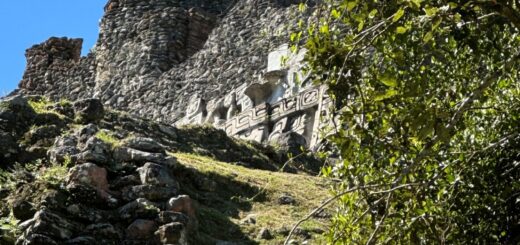
The Lamani Archeological site was developed between 1500-1600BC and was continuously occupied through the 17th century. It is one of Belize’s largest Mayan sites. Highlights include the Jaguar Temple, the High Temple and the Principal Ball Court. The name Lamani means submerged crocodile. Located on a lagoon, it was a main trading hub.
At one time it is said that 63,000 people lived in the area surrounding the site, mostly farmers. No one really knows why it was abandoned, possibly due to deforestation, drought and overpopulation. However, the descendants of the Maya are still very much in the area and are keeping their traditions alive for younger generations. Mayan descendants make up approximately 11% of the Belizean population.
The site had a nice informational museum and also covered picnic tables in case you’d like to bring along a lunch. Unfortunately, it is not accessible due to unlevel ground.

As our hotel was located on the banks of the river in the rainforest, it was a quick hop on a boat and off to a river safari after lunch. Caimans, egrets, iguanas of all types and a fantastic collection of birdlife easily turned a short cruise into a several hours long education on river wildlife. Fascinating! Be sure to pick up a laminated folder on the local birdlife when you can at a souvenir shop, so you can identify the birds while seeing them and then again later from your pictures.

We enjoyed staying at our hotel on the riverbank. As a side note, most of the eating establishments are outdoor and strongly feature black beans, rice, plantains and stewed chicken. The food is organic and wholesome, though it can be a bit monotonous. Outside of the major cities and tourist areas, the food is reasonably priced, but watch out when you get to the beach resorts!
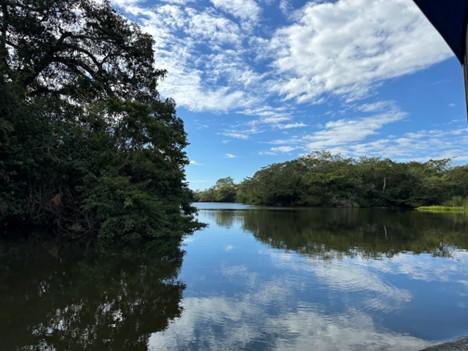
We were off on the start of another great adventure! Next day…to the beach!
Where we stayed: El Gran Mestizo, Nice cabins with pool, on a riverside location. Nice restaurant on site, breakfast included.
How we got there: Flew into Belize City and took a bus to Orange Walk about an hour and half. This was part of a 9-day small group tour through Belize.
General Accessibility Information: Newer hotels are accessible, but many historical sites and other public and private locations are not due to infrastructure, uneven surfaces and lack of ramps. Call in advance to verify and make specialty arrangements. See our sections on specialty apps and accessible travel for more on accessibility assistance.